feature release
reword-nerd v0.7: Updates, feedback, and Share
At a glance
v0.7 makes the release story and a small, privacy-safe feedback path part of the product. It adds a static Updates journal, a machine-readable release ledger, structured public Issue forms, and Share controls that expose only canonical release or workbench URLs.
Added
- Added real static pages for the Updates archive, the Road to v0.6 retrospective, this v0.7 journal entry, an RSS feed, and a sitemap.
- Added a JSON-authoritative release ledger with release classification, publication state, local media policy, related pull requests, and reviewed Markdown custody.
- Added deterministic authoring, release-preparation, validation, and rendering commands that stay offline and make no commit or remote API call.
- Added public bug and feature forms that require a prior search and synthetic-only, non-confidential reports, alongside private vulnerability-reporting guidance, funding, and pull-request templates.
- Added Share controls to the workbench and static Updates archive/posts. Native Share is used only after a direct activation; clipboard and focused manual-copy fallbacks never include session, query, or hash state.
Changed
- Changed the production build to validate the ledger, Markdown, versions, and local media before Vite runs, then render the static Updates files into the finished site.
- Moved the application version to 0.7.0 while keeping prompt-package manifest schema 6 and workbook progress schema 1.
- Grouped Info into Product, Community, and Creator links, added feedback links to Help and static Update footers, and derived the workbench footer release link from the current ledger entry.
Fixed
- Made version disagreement, missing current releases, draft release prose, unsafe Markdown, remote media, broken paths, and unfinished placeholders fail closed.
- Made release preparation idempotent and protected edited prose from being overwritten on a repeated run.
- Removed broad public blank-Issue entry points and a public Discussion destination from the release feedback surface so support routes remain explicit and reviewable.
Why this matters
Release notes are most useful when they explain more than a version number. The ledger gives the build a strict machine-readable contract, while the journal leaves room to explain decisions, limitations, and exact verification in a form that remains readable without JavaScript.
See it in action
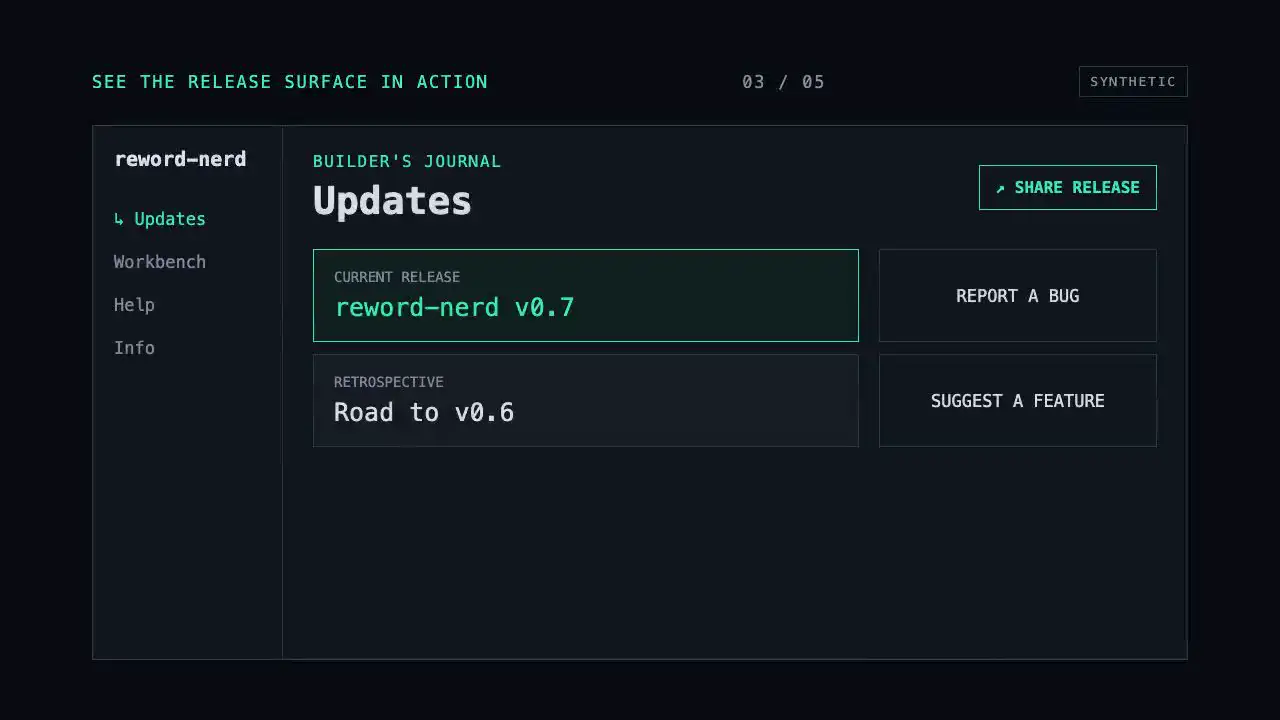
Open the workbench Info dialog for Updates and feedback routes, or open this archive and select Share. The static page remains fully readable without JavaScript; when the optional same-origin enhancement loads, it shares only the canonical URL printed in the page. The silent synthetic walkthrough below shows the Updates archive, feedback links, and Share without loading a third-party player.
How to use it
Visit the Updates archive directly, choose a post to read the full builder's journal, and subscribe to the RSS feed if you want concise release summaries. Use the bug or feature form only with synthetic examples; use the private advisory flow for security reports. In the workbench, use Share from the desktop header or mobile utility menu.
Compatibility and limitations
Updates pages are deliberately static and do not use an SPA or hash router. Their Share enhancement is optional and same-origin, while the content and feedback links remain useful without JavaScript. Native Share availability and clipboard permission vary by browser; cancellation is intentionally silent, and the final fallback gives a selectable canonical URL. Automated browser coverage remains Chromium-focused, so the release does not claim complete cross-browser verification.
Privacy
The workbench remains browser-only. There is no backend, account, analytics, telemetry, model or provider call, credential flow, remote asset, service worker, or new persistence for uploaded documents. The sole storage key remains reword-nerd:preferences:v1. Share adds no counter, tracker, shortener, SDK, storage, or request; it only invokes a user-activated native browser feature or local clipboard/manual-copy fallback. Public authored Updates posts and release media are site material, distinct from uploaded session content, prompt packages, and downloaded progress copies. The release video is synthetic, same-origin, silent, and contains no session document or package content.
Verification
The release pipeline covers ledger safety, remote-media rejection, version and schema agreement, deterministic authoring, edited-prose preservation, static semantic HTML, canonical and social metadata, JSON-LD, RSS, sitemap output, Issue-form parsing, exact community destinations, and native/clipboard/manual Share paths. Publication gates include lint, TypeScript, the unit suite, a Pages-base production build, browser checks, privacy-boundary scans, and git diff --check.
What comes next
The journal will stay small and direct: one reviewed entry per meaningful release, concise RSS summaries, and media only when it clarifies a visual change. Future entries should grow from the same local, deterministic release inventory rather than generated marketing prose.
Feedback and contribution links
Video unavailable? Open the release poster.