Examples
A field guide to the shapes
grooph ships twenty templates. Each is a small diagram of agents, checks, and human gates, with the loops that bring work back, and each is drawn here as a glyph beside when to reach for it and the line that starts it. Pick by shape, then ask for it by name. The poster shows all twenty on one page, and each template's one recorded run, from before grooph was a drawing tool, is at the end.
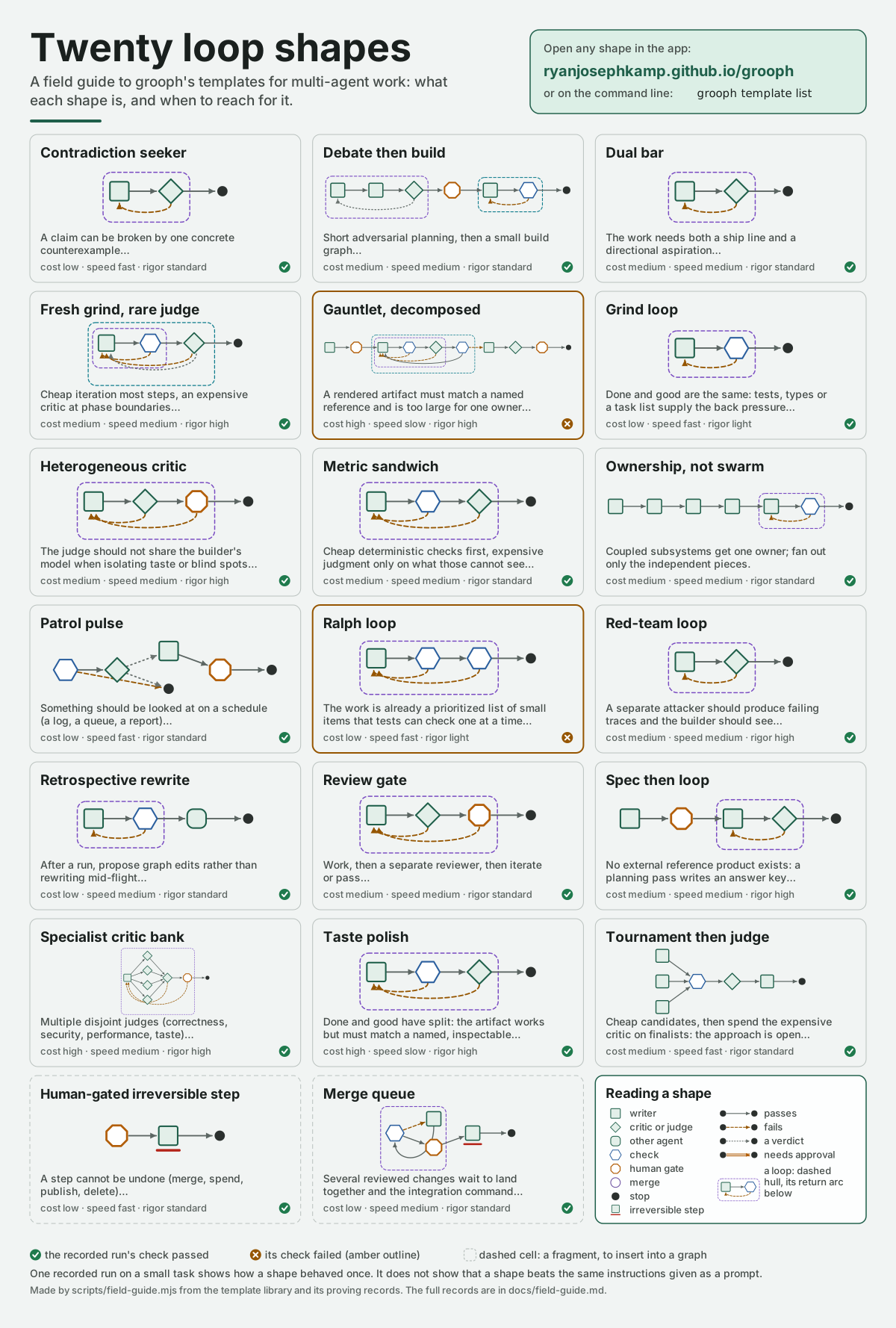
How to read it#
What a loop shape is#
A graph document (graph-ir) says who does what, and in what order. Its shape is the part you can see without reading a word: how many agents there are, which of them build and which judge, where a check or a human gate stands, and which edges send work back to an earlier step. A loop is that return: its member nodes, the edge that sends work back, the bar the work is judged against, and the stops that end it (a bar passed, a round cap, a budget, a human). A shape with no loop runs once, front to back. A template is a graph document with slots to fill; the shape is what stays the same when you fill them.
What the marks in a glyph mean#
The glyph is the wordless picture of a graph, drawn by core's glyph() (grooph glyph <file> draws any document); the app, the CLI and the write-ups all draw it the same way.
| Mark | Means |
|---|---|
| Square | an agent that writes: a builder, a planner, a synthesizer |
| Diamond | an agent that judges: a critic, a judge, a red team |
| Rounded square | any other agent: a lead, a tester, a researcher, a role of its own |
| Hexagon | a check: a command whose result decides |
| Octagon, heavier outline | a human gate: the run halts and asks a person |
| Circle | a merge: parallel work comes together |
| Filled dot | where the graph stops (amber when it stops on a halt) |
| Red bar under a node | a step that cannot be undone (merge, publish, spend, delete) |
| Solid line | the next step runs when the one before it is done or passes |
| Dashed amber line | the step before it failed |
| Dotted line | a judge's verdict decides whether the edge is taken |
| Doubled line | a person's approval is needed to take it |
| Dashed hull | a loop, drawn around its members; each loop has its own color |
| Arc below the nodes | a back edge: work returning to an earlier step |
What the words under a shape mean#
Cost, speed, and rigor are coarse words the template's author chose (low, medium, or high; fast, medium, or slow; light, standard, or high), not measurements. The one measured cost is that of the template's recorded run, at the end of this page.
Shape is one line from grooph shape: counts of agents, checks, gates and loops; "up to N rounds" is the worst case from the loops' round caps (nested loops multiplied); a budget is a loop's own brake. Counts and brakes, never dollars.
Prior art names whose published work a shape or name comes from, and what was taken. It is not an endorsement by that author, and no template claims to beat a named product.
The shapes#
Eighteen whole graphs, then two fragments: nodes that you insert into a graph you already have.
Whole graphs#
- Contradiction seeker: A critic hunts one counterexample to a stated claim on a fixed budget; finding none is a pass, finding one sends it back to the builder.
- Debate then build: Two planners argue opposite approaches for a capped number of rounds, a judge writes the plan, a human approves it, and a small grind loop builds it.
- Dual bar: A builder and an isolated critic loop against two lines: a reachable ship line that stops the loop, and an aspiration that only steers the findings.
- Fresh grind, rare judge: A fast builder grinds each phase against the tests; an expensive judge runs only at phase boundaries, against a phase checklist.
- Gauntlet, decomposed: A planner cuts the work into pieces and a human approves the cut; one piece at a time an owner polishes while a fresh frontier critic compares captures blind against the reference; an integrator and a final blind comparison close it.
- Grind loop: A fast builder works against the test suite until it passes, bounded by rounds and minutes.
- Heterogeneous critic: The review gate with the critic on a different model tier from the builder, so it need not share the builder's blind spots.
- Metric sandwich: Cheap deterministic checks run first; an expensive critic judges only what they cannot see, and either failure returns to the builder.
- Ownership, not swarm: Coupled subsystems get one owner each, in sequence; only the independent pieces fan out to fast workers; an integrator joins them and the tests close it.
- Patrol pulse: A scan lists candidate signals, a read-only investigator judges them against the project and the existing tickets, a writer files the new ones to the ticket store, and a human prioritizes; one pulse is one run.
- Ralph loop: A fresh builder takes the top unchecked item of a plan file each round, commits on green and appends what it learned to an agent file, until the plan is empty.
- Red-team loop: A separate attacker records reproducible failing traces; the builder is given only the traces, until no new one appears.
- Retrospective rewrite: A grind loop that ends, pass or fail, with a researcher reading the run's notes and proposing graph changes for the human to adopt.
- Review gate: A builder works, an isolated critic checks the change against a written checklist, failures loop back, and a human approves the merge.
- Spec then loop: A planner writes the answer key, a human approves it, then a builder and an isolated critic loop against it.
- Specialist critic bank: Four fresh specialist critics review in parallel, a triage judge merges their findings by severity, and the change loops until nothing blocker or major remains.
- Taste polish: One owner polishes an existing artifact while an isolated frontier critic compares readable captures against a named reference, bounded by rounds, budget and a human check-in.
- Tournament then judge: Three fast candidates build in parallel, a cheap check drops the broken ones, a frontier judge picks one finalist, and a builder finishes it.
Fragments#
- Human-gated irreversible step: A human gate, then the one node that performs an irreversible action, then a stop: insert it before any merge, publish, spend or delete.
- Merge queue: An integration check on the queued batch; a failure goes to a bisector that finds the change at fault and leaves the rest queued; a pass waits for a human, who lets one node land the batch.
Whole graphs#
Contradiction seeker#

Use when. A claim can be broken by one concrete counterexample (a property, an invariant, an edge case), and a bounded search for it is worth more than an open-ended review.
Not for. Claims no single input can break (style, clarity), or proving correctness: a hunt that finds nothing is evidence, not proof.
Cost, speed, rigor. Low cost, fast speed, standard rigor.
Shape. 2 agents · 1 loop · up to 3 rounds · 8 dispatches
Use it.
grooph template use contradiction-seeker --name "My graph" \
  --set task="..." --set test-command="..." --set claim="..." \
  --out my-graph.grooph.json
In a Claude Code session with the grooph-design skill:
/grooph-design propose a graph for <what you are building>, starting from the contradiction-seeker template
Open it in the app · the template document
Debate then build#

Use when. Short adversarial planning, then a small build graph: the right approach is genuinely unclear and a wrong choice is expensive to undo.
Not for. Work with an obvious approach, or where drafts are cheaper than arguments (use tournament-then-judge).
Cost, speed, rigor. Medium cost, medium speed, standard rigor.
Shape. 4 agents · 1 check · 1 gate · 2 loops · up to 7 rounds · Debate: 8 dispatches · Build: 30 minutes
Use it.
grooph template use debate-then-build --name "My graph" \
  --set task="..." --set test-command="..." \
  --out my-graph.grooph.json
In a Claude Code session with the grooph-design skill:
/grooph-design propose a graph for <what you are building>, starting from the debate-then-build template
Open it in the app · the template document
Dual bar#

Use when. The work needs both a ship line and a directional aspiration: good enough to ship is clear, and better is worth pointing at without ever blocking.
Not for. Work where only the aspiration is written down; a bar that cannot be met never stops, so write the ship line first.
Cost, speed, rigor. Medium cost, medium speed, standard rigor.
Shape. 2 agents · 1 loop · up to 5 rounds · 12 dispatches
Use it.
grooph template use dual-bar --name "My graph" \
  --set task="..." --set test-command="..." --set ship-line="..." --set aspiration="..." \
  --out my-graph.grooph.json
In a Claude Code session with the grooph-design skill:
/grooph-design propose a graph for <what you are building>, starting from the dual-bar template
Open it in the app · the template document
Fresh grind, rare judge#

Use when. Cheap iteration most steps, an expensive critic at phase boundaries: long work splits into phases that tests can drive but only judgment can sign off.
Not for. Short tasks with one phase (use grind-loop or review-gate), or work where the tests cannot drive any of the steps.
Cost, speed, rigor. Medium cost, medium speed, high rigor.
Shape. 2 agents · 1 check · 2 loops · up to 30 rounds · Grind: 20 minutes · Phases: 55 dispatches
Use it.
grooph template use fresh-grind-rare-judge --name "My graph" \
  --set task="..." --set test-command="..." --set phase-checklist="..." \
  --out my-graph.grooph.json
In a Claude Code session with the grooph-design skill:
/grooph-design propose a graph for <what you are building>, starting from the fresh-grind-rare-judge template
Open it in the app · the template document
Gauntlet, decomposed#

Use when. A rendered artifact must match a named reference and is too large for one owner and one critic: the pieces have real seams, each can be captured and judged alone, and they are coupled enough to build in sequence.
Not for. One small artifact (taste-polish), no reference (spec-then-loop), or independent pieces that could fan out (ownership-not-swarm); never a way to keep going until the reference loses.
Cost, speed, rigor. High cost, slow speed, high rigor.
Shape. 5 agents · 2 checks · 2 gates · 2 loops · up to 16 rounds · Polish a piece: 10 dispatches · Pieces: 42 dispatches
Prior art. Matt Shumer's Gauntlet Loop and the Claude of Duty repository: decompose, then builder plus fresh critic per piece against a real reference, blind side by side; here bounded, and pieces run in sequence because the repository's own note says fan-out lost on coupled work.
Use it.
grooph template use gauntlet-decomposed --name "My graph" \
  --set task="..." --set reference="..." --set capture-command="..." \
  --out my-graph.grooph.json
In a Claude Code session with the grooph-design skill:
/grooph-design propose a graph for <what you are building>, starting from the gauntlet-decomposed template
Open it in the app · the template document
Grind loop#

Use when. Done and good are the same: tests, types or a task list supply the back pressure, so a passing check is the finish line.
Not for. Work where passing tests is not the same as good (taste, design, prose); use review-gate or taste-polish there.
Cost, speed, rigor. Low cost, fast speed, light rigor.
Shape. 1 agent · 1 check · 1 loop · up to 5 rounds · 30 minutes
Use it.
grooph template use grind-loop --name "My graph" \
  --set task="..." --set test-command="..." \
  --out my-graph.grooph.json
In a Claude Code session with the grooph-design skill:
/grooph-design propose a graph for <what you are building>, starting from the grind-loop template
Open it in the app · the template document
Heterogeneous critic#

Use when. The judge should not share the builder's model when isolating taste or blind spots matters: a same-model critic may keep approving the mistakes the builder makes.
Not for. Cheap, routine changes where a same-tier review-gate is enough, or checks a test can make; a stronger critic costs more every round.
Cost, speed, rigor. Medium cost, medium speed, high rigor.
Shape. 2 agents · 1 gate · 1 loop · up to 4 rounds · 10 dispatches
Use it.
grooph template use heterogeneous-critic --name "My graph" \
  --set task="..." --set test-command="..." --set checklist="..." \
  --out my-graph.grooph.json
In a Claude Code session with the grooph-design skill:
/grooph-design propose a graph for <what you are building>, starting from the heterogeneous-critic template
Open it in the app · the template document
Metric sandwich#

Use when. Cheap deterministic checks first, expensive judgment only on what those cannot see: lint and tests catch most failures, and a reviewer should not spend a round on them.
Not for. Work with no deterministic check to run first (use review-gate), or where the checks are the whole story (use grind-loop).
Cost, speed, rigor. Medium cost, medium speed, standard rigor.
Shape. 2 agents · 1 check · 1 loop · up to 5 rounds · 16 dispatches
Use it.
grooph template use metric-sandwich --name "My graph" \
  --set task="..." --set test-command="..." --set checklist="..." \
  --out my-graph.grooph.json
In a Claude Code session with the grooph-design skill:
/grooph-design propose a graph for <what you are building>, starting from the metric-sandwich template
Open it in the app · the template document
Ownership, not swarm#

Use when. Coupled subsystems get one owner; fan out only the independent pieces. The work spans a shared core and several leaf pieces that touch nothing else.
Not for. Work that is all coupled (use one builder in a grind-loop or review-gate) or all independent (a fan-out alone); and never as a way to parallelise a shared core.
Cost, speed, rigor. Medium cost, medium speed, standard rigor.
Shape. 5 agents · 1 check · 1 loop · up to 3 rounds · 30 minutes
Prior art. Claude of Duty process note (Matt Shumer): sequential ownership beat parallel fan-out on coupled systems in the repository's own write-up.
Use it.
grooph template use ownership-not-swarm --name "My graph" \
  --set task="..." --set test-command="..." --set subsystem-a="..." --set subsystem-b="..." \
  --out my-graph.grooph.json
In a Claude Code session with the grooph-design skill:
/grooph-design propose a graph for <what you are building>, starting from the ownership-not-swarm template
Open it in the app · the template document
Patrol pulse#

Use when. Something should be looked at on a schedule (a log, a queue, a report) and the output of each look is a triaged record for a human, never a change: run the package under the harness's scheduler and each pulse is a run.
Not for. Anything that should change code in the same run (use a loop with a builder), or a watch with no durable store to file into: the memory is the project's ticket file or database, named by the slot, not grooph.
Cost, speed, rigor. Low cost, fast speed, standard rigor.
Shape. 2 agents · 1 check · 1 gate · no loop
Prior art.
- u/croovies's "Lloyd" heartbeat orchestrator, as written up by explainx.ai (2026-08-14; a secondary source): a standing checklist per pulse, a read-only investigator, findings to a durable ticket store, humans prioritize.
- Steve Yegge's Gas Town patrols: patrol agents that loop by design; here one pulse is one run.
Use it.
grooph template use patrol-pulse --name "My graph" \
  --set task="..." --set scan-command="..." --set ticket-store="..." \
  --out my-graph.grooph.json
In a Claude Code session with the grooph-design skill:
/grooph-design propose a graph for <what you are building>, starting from the patrol-pulse template
Open it in the app · the template document
Ralph loop#

Use when. The work is already a prioritized list of small items that tests can check one at a time, and you want a fresh context per item with the plan and an agent file as the only memory.
Not for. One item that needs judgment rather than a test (use review-gate or taste-polish), or a plan whose items are too large or too coupled to finish one at a time.
Cost, speed, rigor. Low cost, fast speed, light rigor.
Shape. 1 agent · 2 checks · 1 loop · up to 5 rounds · 17 dispatches
Prior art. Geoffrey Huntley's ralph loop: one prompt piped into a fresh session per pass; one item of work per pass from a plan file; state on disk; the human as the brake, here replaced by stops.
Use it.
grooph template use ralph-loop --name "My graph" \
  --set task="..." --set plan-file="..." --set agent-file="..." --set test-command="..." \
  --out my-graph.grooph.json
In a Claude Code session with the grooph-design skill:
/grooph-design propose a graph for <what you are building>, starting from the ralph-loop template
Open it in the app · the template document
Red-team loop#

Use when. A separate attacker should produce failing traces and the builder should see only those: hardening against inputs or abuse nobody has listed yet.
Not for. Work with a known list of cases to satisfy (use grind-loop against tests), or judging quality rather than breaking things.
Cost, speed, rigor. Medium cost, medium speed, high rigor.
Shape. 2 agents · 1 loop · up to 5 rounds · 12 dispatches
Use it.
grooph template use red-team-loop --name "My graph" \
  --set task="..." --set test-command="..." --set attack-surface="..." \
  --out my-graph.grooph.json
In a Claude Code session with the grooph-design skill:
/grooph-design propose a graph for <what you are building>, starting from the red-team-loop template
Open it in the app · the template document
Retrospective rewrite#

Use when. After a run, propose graph edits rather than rewriting mid-flight: the graph is being tuned across runs and the human wants every change as a proposal.
Not for. One-off tasks nobody will run again, or when the lead should adapt the graph during the run (the default adaptive level does that).
Cost, speed, rigor. Low cost, medium speed, standard rigor.
Shape. 2 agents · 1 check · 1 loop · up to 5 rounds · 30 minutes
Use it.
grooph template use retrospective-rewrite --name "My graph" \
  --set task="..." --set test-command="..." \
  --out my-graph.grooph.json
In a Claude Code session with the grooph-design skill:
/grooph-design propose a graph for <what you are building>, starting from the retrospective-rewrite template
Open it in the app · the template document
Review gate#

Use when. Work, then a separate reviewer, then iterate or pass: the change needs a second pair of eyes against a checklist that already exists.
Not for. Work where the tests alone decide done (use grind-loop), or where nobody has written down what good means yet (use spec-then-loop).
Cost, speed, rigor. Medium cost, medium speed, standard rigor.
Shape. 2 agents · 1 gate · 1 loop · up to 4 rounds · 10 dispatches
Use it.
grooph template use review-gate --name "My graph" \
  --set task="..." --set test-command="..." --set checklist="..." \
  --out my-graph.grooph.json
In a Claude Code session with the grooph-design skill:
/grooph-design propose a graph for <what you are building>, starting from the review-gate template
Open it in the app · the template document
Spec then loop#

Use when. No external reference product exists: a planning pass writes an answer key (ACCEPTANCE.md) that becomes the bar. The default for zero-to-one work.
Not for. Work with a reference or checklist already in hand (use review-gate or taste-polish), or changes so small that writing acceptance criteria costs more than the change.
Cost, speed, rigor. Medium cost, medium speed, high rigor.
Shape. 3 agents · 1 gate · 1 loop · up to 4 rounds · 10 dispatches
Prior art. Answer-key-first Gauntlet, a community modification of Matt Pocock's Wayfinder: write the spec and a pass/fail answer key before the loop; the modification is known from a secondary write-up, not a primary source.
Use it.
grooph template use spec-then-loop --name "My graph" \
  --set task="..." --set test-command="..." \
  --out my-graph.grooph.json
In a Claude Code session with the grooph-design skill:
/grooph-design propose a graph for <what you are building>, starting from the spec-then-loop template
Open it in the app · the template document
Specialist critic bank#

Use when. Multiple disjoint judges (correctness, security, performance, taste) should each look at the change, and their findings need merging by severity.
Not for. Small or low-risk changes, where one review-gate critic is enough; four reviewers and a judge are each a dispatch, every round.
Cost, speed, rigor. High cost, medium speed, high rigor.
Shape. 6 agents · 1 gate · 1 loop · up to 4 rounds · 26 dispatches
Use it.
grooph template use specialist-critic-bank --name "My graph" \
  --set task="..." --set test-command="..." \
  --out my-graph.grooph.json
In a Claude Code session with the grooph-design skill:
/grooph-design propose a graph for <what you are building>, starting from the specialist-critic-bank template
Open it in the app · the template document
Taste polish#

Use when. Done and good have split: the artifact works but must match a named, inspectable reference, and the polish can be judged from captures.
Not for. Zero-to-one work with no reference (use spec-then-loop), or a default for every task: unbounded 'keep going until it beats the reference' is exactly what the stops here prevent.
Cost, speed, rigor. High cost, slow speed, high rigor.
Shape. 2 agents · 1 check · 1 loop · up to 5 rounds · 16 dispatches
Prior art. Matt Shumer's Gauntlet Loop (Claude of Duty): the bounded form of the Gauntlet: one owner, an isolated critic against a named reference, real stops.
Use it.
grooph template use taste-polish --name "My graph" \
  --set task="..." --set reference="..." --set capture-command="..." \
  --out my-graph.grooph.json
In a Claude Code session with the grooph-design skill:
/grooph-design propose a graph for <what you are building>, starting from the taste-polish template
Open it in the app · the template document
Tournament then judge#

Use when. Cheap candidates, then spend the expensive critic on finalists: the approach is open, drafts are cheap, and comparing working options beats arguing about them.
Not for. Work with one obvious approach, or coupled changes to a shared core: candidates that must touch the same files cannot run side by side.
Cost, speed, rigor. Medium cost, fast speed, standard rigor.
Shape. 5 agents · 1 check · no loop
Use it.
grooph template use tournament-then-judge --name "My graph" \
  --set task="..." --set test-command="..." --set criteria="..." \
  --out my-graph.grooph.json
In a Claude Code session with the grooph-design skill:
/grooph-design propose a graph for <what you are building>, starting from the tournament-then-judge template
Open it in the app · the template document
Fragments#
Human-gated irreversible step#

Use when. A step cannot be undone (merge, spend, publish, delete) and must wait for a human decision; this fragment satisfies E_IRREVERSIBLE_NO_GATE.
Not for. Reversible steps, where a gate only slows the run; and it gates only the way in you connect to it: every edge into the action must pass the gate.
Cost, speed, rigor. Low cost, fast speed, standard rigor.
Shape. 1 agent · 1 gate · no loop
Use it.
grooph template insert human-gated-irreversible --into my-graph.grooph.json \
  --set action="..." --set irreversible="..." \
  --write
In a Claude Code session with the grooph-design skill:
/grooph-design add the human-gated-irreversible fragment to my graph
Open it in the app · the template document
Merge queue#

Use when. Several reviewed changes wait to land together and the integration command (build, lint, tests) is the arbiter: insert this before the host's stop node so a batch lands only green and only on a human's word.
Not for. A single change (human-gated-irreversible is enough), or a host whose changes are not yet reviewed: the queue integrates, it does not review.
Cost, speed, rigor. Low cost, medium speed, standard rigor.
Shape. 2 agents · 1 check · 1 gate · 1 loop · up to 4 rounds · 9 dispatches
Prior art.
- Steve Yegge's Gas Town Refinery: a merge queue that integrates a batch, bisects on failure and lands by a human's word.
- Bors: batch then bisect.
Use it.
grooph template insert merge-queue --into my-graph.grooph.json \
  --set integration-command="..." --set queue-file="..." --set land-command="..." \
  --write
In a Claude Code session with the grooph-design skill:
/grooph-design add the merge-queue fragment to my graph
Open it in the app · the template document
The recorded runs (experimental)#
Before grooph was a drawing tool, each template was compiled into a package and run once, headless, in Claude Code, on a small task. The harness's output, a one-screen write-up, and a row in the spend ledger are kept under experiments/patterns/<id>/, and the cost below is the ledger's. Check is scripts/prove-pattern.sh --check run again on the kept record: it asks whether selected parts of it match the diagram (the named agents ran as their own subagents, the run ended as written, the notes are whole). A run that fails the check is kept as it ran, with the check's findings.
A passing check is not a claim that the template improves the work: a plain prompt with the same design scored the same where that was measured (what the experiments found). A write-up says what happened in one run; it is not a benchmark.
The latest kept run of each of the twenty templates is counted: eighteen passed their check and two did not (gauntlet-decomposed and ralph-loop); the twenty kept runs cost $41.12 (the whole proving ledger, which also counts the runs since replaced and a few probes, stands at $62.68). Seven earlier runs are kept beside them; six of those fail their check.
Contradiction seeker#
One recorded run, 20260919-1233-k7qm on Claude Code 2.1.276, of Contradiction seeker.
- Check: passed.
- Rounds: last round 0; no back edge was taken.
- Ended: at the stop node
done; the stopbar-passedfired. - Cost: $1.06 (ledger invocation 4).
- Write-up and evidence: what happened in that one run, in the author's words.
Debate then build#
One recorded run, 20260920-185756 on Claude Code 2.1.278, of Debate then build.
- Check: passed.
- Rounds: last round 0; no back edge was taken.
- Ended: halted at
plan-gate. - Cost: $1.73 (ledger invocation 15).
- Write-up and evidence: what happened in that one run, in the author's words.
Dual bar#
One recorded run, 20260920-191110 on Claude Code 2.1.278, of Dual bar.
- Check: passed.
- Rounds: last round 0; no back edge was taken.
- Ended: at the stop node
done; the stopbar-passedfired. - Cost: $1.67 (ledger invocation 17).
- Write-up and evidence: what happened in that one run, in the author's words.
Fresh grind, rare judge#
One recorded run, 20260921-044114 on Claude Code 2.1.278, of Fresh grind, rare judge.
- Check: passed.
- Rounds: last round 1; a back edge was taken (
e-judge-next-phase), caught by judge (next-phase). - Ended: at the stop node
done. - Cost: $2.97 (ledger invocation 26).
- An earlier run of this template,
20260920-195457, is kept inexperiments/patterns/fresh-grind-rare-judge/run-1/; its check failed (PHASE-REVIEW.md was also written by general-purpose, not only judge; judge never read or ran the held-out evidence, so its judgment was not made against it). The run above is the later one. - Write-up and evidence: what happened in that one run, in the author's words.
Gauntlet, decomposed#
One recorded run, 20261004-224501 on Claude Code 2.1.289, of Gauntlet, decomposed.
- Check: failed, on ten findings; the first: integrator never ran as its own subagent (no summary-card--integrator transcript). The record is kept as it ran, and the findings are the check's own words, below.
- Rounds: last round 1; a back edge was taken (
e-next-piece-pass). - Ended: at the stop node
done; the stophumanfired. - Cost: $3.64 (ledger invocations 32 and 33).
- An earlier run of this template,
20260922-151855, is kept inexperiments/patterns/gauntlet-decomposed/run-1/; its check failed (integrator never ran as its own subagent (no summary-card--integrator transcript); the lead never dispatched summary-card--integrator; no note at node:integrator; final-critic never ran as its own subagent (no summary-card--final-critic transcript); the lead never dispatched summary-card--final-critic; no note at node:final-critic; PIECES.md was also written by summary-card--critic, not only planner; final-critic never wrote FINAL.md itself; the run ended by stop human; the template expects one of: halt at release-gate; final-critic never read or ran the held-out evidence, so its judgment was not made against it). The run above is the later one. - Write-up and evidence: what happened in that one run, in the author's words.
The check's ten findings
- integrator never ran as its own subagent (no summary-card--integrator transcript)
- the lead never dispatched summary-card--integrator
- no note at node:integrator
- final-critic never ran as its own subagent (no summary-card--final-critic transcript)
- the lead never dispatched summary-card--final-critic
- no note at node:final-critic
- final-critic never wrote FINAL.md itself
- replaying every amendment's patch on the source does not give the working copy
- note n-0019: loop:polish records 3 dispatches, but 6 started line(s) at its members precede it
- final-critic never read or ran the held-out evidence, so its judgment was not made against it
Grind loop#
One recorded run, 20260919-1230-k7qm on Claude Code 2.1.276, of Grind loop.
- Check: passed.
- Rounds: last round 0; no back edge was taken.
- Ended: at the stop node
done. - Cost: $0.66 (ledger invocation 3).
- Write-up and evidence: what happened in that one run, in the author's words.
Heterogeneous critic#
One recorded run, 20260920-192538 on Claude Code 2.1.278, of Heterogeneous critic.
- Check: passed.
- Rounds: last round 1; a back edge was taken (
e-critic-fail), caught by critic (fail). - Ended: halted at
merge-gate. - Cost: $3.40 (ledger invocation 19).
- Write-up and evidence: what happened in that one run, in the author's words.
Metric sandwich#
One recorded run, 20260919-1241-k7qm on Claude Code 2.1.276, of Metric sandwich.
- Check: passed.
- Rounds: last round 0; no back edge was taken.
- Ended: at the stop node
done; the stopbar-passedfired. - Cost: $1.49 (ledger invocation 6).
- Write-up and evidence: what happened in that one run, in the author's words.
Ownership, not swarm#
One recorded run, 20260920-193520 on Claude Code 2.1.278, of Ownership, not swarm.
- Check: passed.
- Rounds: last round 0; no back edge was taken.
- Ended: at the stop node
done. - Cost: $3.12 (ledger invocation 20).
- Write-up and evidence: what happened in that one run, in the author's words.
Patrol pulse#
One recorded run, 20261005-042756 on Claude Code 2.1.289, of Patrol pulse.
- Check: passed.
- Rounds: no loop round was recorded; no back edge was taken.
- Ended: halted at
prioritize. - Cost: $0.73 (ledger invocation 35).
- An earlier run of this template,
20260922-050527, is kept inexperiments/patterns/patrol-pulse/run-1/; its check passed. The run above is the later one. - An earlier run of this template,
20261004-225445, is kept inexperiments/patterns/patrol-pulse/run-2/; its check failed (investigator never ran as its own subagent (no orders-api-patrol--investigator transcript); the lead never dispatched orders-api-patrol--investigator; no note at node:investigator; ticket-writer never ran as its own subagent (no orders-api-patrol--ticket-writer transcript); the lead never dispatched orders-api-patrol--ticket-writer; no note at node:ticket-writer; investigator never wrote PULSE.md itself; ticket-writer never wrote FILED.md itself; replaying every amendment's patch on the source does not give the working copy; TICKETS.md: 0 added line(s) match /^## T-/; the template expects 1). The run above is the later one. - Write-up and evidence: what happened in that one run, in the author's words.
Ralph loop#
One recorded run, 20260922-052016 on Claude Code 2.1.278, of Ralph loop.
- Check: failed, on one finding: builder read the held-out evidence it was told is not its to read (1 tool use(s)). The record is kept as it ran.
- Rounds: last round 4; a back edge was taken (
e-plan-check-failande-tests-fail), caught by plan-check and tests. - Ended: at the stop node
done. - Cost: $2.52 (ledger invocation 29).
- Write-up and evidence: what happened in that one run, in the author's words.
Red-team loop#
One recorded run, 20260920-191614 on Claude Code 2.1.278, of Red-team loop.
- Check: passed.
- Rounds: last round 0; no back edge was taken.
- Ended: at the stop node
done. - Cost: $2.15 (ledger invocation 18).
- Write-up and evidence: what happened in that one run, in the author's words.
Retrospective rewrite#
One recorded run, 20260920-185135 on Claude Code 2.1.278, of Retrospective rewrite.
- Check: passed.
- Rounds: last round 0; no back edge was taken.
- Ended: at the stop node
done. - Cost: $1.45 (ledger invocation 14).
- Write-up and evidence: what happened in that one run, in the author's words.
Review gate#
One recorded run, 20260920-172408 on Claude Code 2.1.276, of Review gate.
- Check: passed.
- Rounds: last round 0; no back edge was taken.
- Ended: halted at
merge-gate. - Cost: $1.36 (ledger invocation 9).
- An earlier run of this template,
20260919-1236-k7q2, is kept inexperiments/patterns/review-gate/run-1/; its check failed (the final note names no stop, stop node or halt at a gate). The run above is the later one. - Write-up and evidence: what happened in that one run, in the author's words.
Spec then loop#
One recorded run, 20260920-172850 on Claude Code 2.1.276, of Spec then loop.
- Check: passed.
- Rounds: last round 0; no back edge was taken.
- Ended: at the stop node
done; the stopbar-passedfired. - Cost: $2.44 (ledger invocations 10 and 11).
- An earlier run of this template,
20260919-1245-k7qz, is kept inexperiments/patterns/spec-then-loop/run-1/; its check failed (the first invocation did not end in a halt at spec-gate). The run above is the later one. - Write-up and evidence: what happened in that one run, in the author's words.
Specialist critic bank#
One recorded run, 20260921-032821 on Claude Code 2.1.278, of Specialist critic bank.
- Check: passed.
- Rounds: last round 0; no back edge was taken.
- Ended: halted at
gate. - Cost: $3.10 (ledger invocation 25).
- An earlier run of this template,
20260920-200356, is kept inexperiments/patterns/specialist-critic-bank/run-1/; its check failed (the final note names no stop, stop node or halt at a gate; the run ended by nothing named; the template expects one of: halt at gate; note n-0014: loop:review records 8 dispatches, but 6 started line(s) at its members precede it; note n-0027: loop:review records 16 dispatches, but 12 started line(s) at its members precede it). The run above is the later one. - Write-up and evidence: what happened in that one run, in the author's words.
Taste polish#
One recorded run, 20260920-194427 on Claude Code 2.1.278, of Taste polish.
- Check: passed.
- Rounds: last round 1; a back edge was taken (
e-critic-fail), caught by critic (fail). - Ended: at the stop node
done; the stopbar-passedfired. - Cost: $3.17 (ledger invocation 21).
- Write-up and evidence: what happened in that one run, in the author's words.
Tournament then judge#
One recorded run, 20260920-190434 on Claude Code 2.1.278, of Tournament then judge.
- Check: passed.
- Rounds: no loop round was recorded; no back edge was taken.
- Ended: at the stop node
done. - Cost: $2.64 (ledger invocation 16).
- Write-up and evidence: what happened in that one run, in the author's words.
Human-gated irreversible step#
One recorded run, 20260920-184824 on Claude Code 2.1.278, of Human-gated irreversible step.
- Check: passed.
- Rounds: last round 0; no back edge was taken.
- Ended: halted at
gate. - Cost: $0.70 (ledger invocation 13).
- Write-up and evidence: what happened in that one run, in the author's words.
Merge queue#
One recorded run, 20260922-051355 on Claude Code 2.1.278, of Merge queue.
- Check: passed.
- Rounds: last round 1; a back edge was taken (
e-bisect-integrate), caught by integrate. - Ended: halted at
land-gate. - Cost: $1.09 (ledger invocation 28).
- Write-up and evidence: what happened in that one run, in the author's words.
Generated by scripts/field-guide.mjs from patterns/ and experiments/patterns/, like field-guide/ beside it (the glyphs and the poster). Edit a template or a record, then run node scripts/field-guide.mjs; CI fails when any of them is stale.