A graduate student in computer science at the University of Cincinnati, with a degree in
neuroscience and another in mathematics. Clipped to the box are two real CT scans, the
samples that ship in the volume viewer of Splashery, his
Gaussian splat playground: a walnut, and the head of a young gar.
Move acrossTap, or drag sideways on,
any picture to cut the scan there. The last picture is the scan with that corner
carved away; drag it to turn it. The strip underneath sets the window, and the two
labels on the film change the scan.
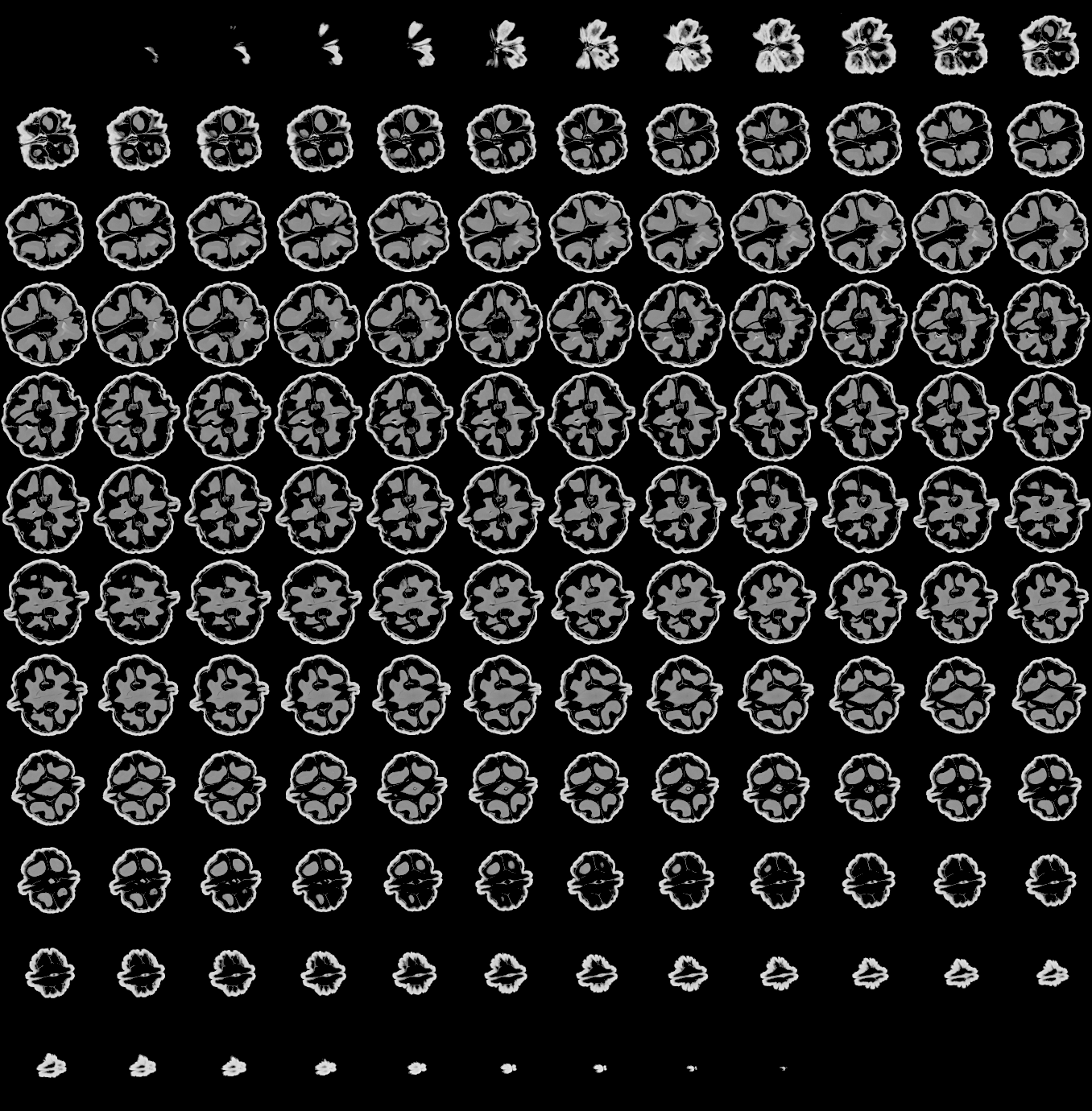
Walnut 1 from the CWI cone-beam CT collection, averaged to 0.3 mm voxels. Every picture
is read live from the scan's 1,845,290 voxels.
A 12.8 mm gar larva, micro-CT by Brian Metscher, averaged to 17.7 µm voxels and cropped
to the fish. Every picture is read live from the scan's 2,854,656 voxels.
Credits are at the foot of the page.
Series 1 · 2026 to present
Splashery
An interactive Gaussian splat playground that runs entirely in the browser. Pick a toy (a
real captured object, or one generated from a seed), spin it, poke it, blow on it, splash
paint on it, drop it, watch it fall apart and come back, make your own, and share it as a
link, an embed, a GIF or a video.
Ryan defined the project's vision and its toy categories, refined the interaction design
through hands-on testing, and contributed mathematical recipes.
A · THE VOLUME VIEWER
Open a scan of your own
The volume viewer opens a CT, MRI or microscope scan (DICOM, NIfTI, a TIFF stack or a raw
volume) on your device, so nothing is uploaded, and draws it as splats. It has window and
level with presets for bone, soft tissue and the full range, a transfer function for
colors and opacity, a cut plane on each axis that a drag moves, a thin-slice view, and a
maximum-intensity picture.
Its samples are real scans of things that aren't people: the walnut and the young gar's
head on the box above. The viewer sits behind Splashery's
labs switch.
THE WHOLE EXAM · 142 SLICES · 12 TO A ROW
The ring marks the slice in the top-down picture. Choose any slice to hang it there.
B · HOW A CT SEES
Toys that show how the machines see
A CT ring sweeps along a nautilus shell and builds its volume slice by slice, then a drag
cuts into it. A kiwi's or an orange's MRI slices scroll under a drag. Bags ride a belt
through an airport scanner. Pollen, diatoms and a snowflake appear as a scanning electron
microscope sees them, and a mug of tea cools in a thermal camera's false colors.
On this page: the slice you chose, rebuilt from nothing but its own X-ray shadows by
filtered back projection. One view is a smear. Slide toward 180.
SHADOWSREBUILT
C · THE ANATOMY ATLAS
A body, peeled layer by layer
A standing figure about 1.8 m tall, peeled like a clinical atlas. A tap opens the outer
layer along its seams and lifts it away; after the organs, a tap brings every layer back
in order. A labels switch lists the parts and highlights the one you tapped.
Four films stacked on the box. Click the top one to peel it.
D · THE REAL THING
The same walnut, in Splashery
Everything above is this page's own drawing of the scan. This one is Splashery's: its
walnut toy in the embed player, the same CT scan drawn as volume splats. It turns when
idle and you can orbit it. In the playground you can cut it, or show only its dense
shell.
It comes from Splashery's own site, and only when you ask.
Series 2 · the other nine
Findings
2 · 2026 TO PRESENT
grooph
Visual loop graphs for coding-agent workflows. You draw who builds, who checks, where a
person decides and when the work stops. grooph checks that every loop names a stop, then
compiles the graph into a prompt package for a separate coding-agent harness. It runs no
agent and calls no model, and graphs stay on your device.
A Chrome extension that collects links with their anchor text and URL in separate fields,
for reviewing sources and exporting a research collection. No account, ads, telemetry or
backend.
An anagram finder. Give it any text and it returns every way those exact letters can be
re-partitioned into real English words, by a deterministic search.
A local-first browser workbench that turns a reviewed document, or a set of images, into
a portable workbook of rewriting prompts. Everything stays reviewable in the browser, the
download is a separate, explicit step, and the application contacts no model provider
itself.
A local-first literature-monitoring desktop application. It runs scheduled searches
across open-access scholarly sources, removes duplicates, and compiles reading reports,
with optional summaries.
A free, open, continuously maintained list of valid English words, about 345,000 of them,
with the provenance of every word (which sources attested it, and when), auditable
correction records, and a browser explorer.
The Speed-Accuracy Trade-Off in Perceptual Decision-Making
Ryan's undergraduate research capstone: evidence accumulation modeled as a diffusion
process, with dynamic programming and value iteration used to study decision boundaries
in a simulated obstacle-avoidance scenario for an autonomous vehicle.